
Summary
In the 2024-2025 fiscal year, the Colorado State Library (CSL) hosted 67 webinars along with numerous in-person trainings, drop-in sessions, information sharing meetings, and cohort trainings. From these, we received 1028 post-program surveys. Overall, 68% of respondents said that the training they attended was excellent and 95% said it was either above average or excellent. Furthermore, 85% of respondents said they would go to another training from CSL on the same topic. The majority of attendees were from public libraries (88%) followed by school library workers (6%) and academic library workers (3%). Respondents were given an opportunity to answer open-ended questions about their experience. Below is an analysis of those answers, but one respondent summed these up well saying their session was “Fun, functional, fascinating.”
Learning and Applicability
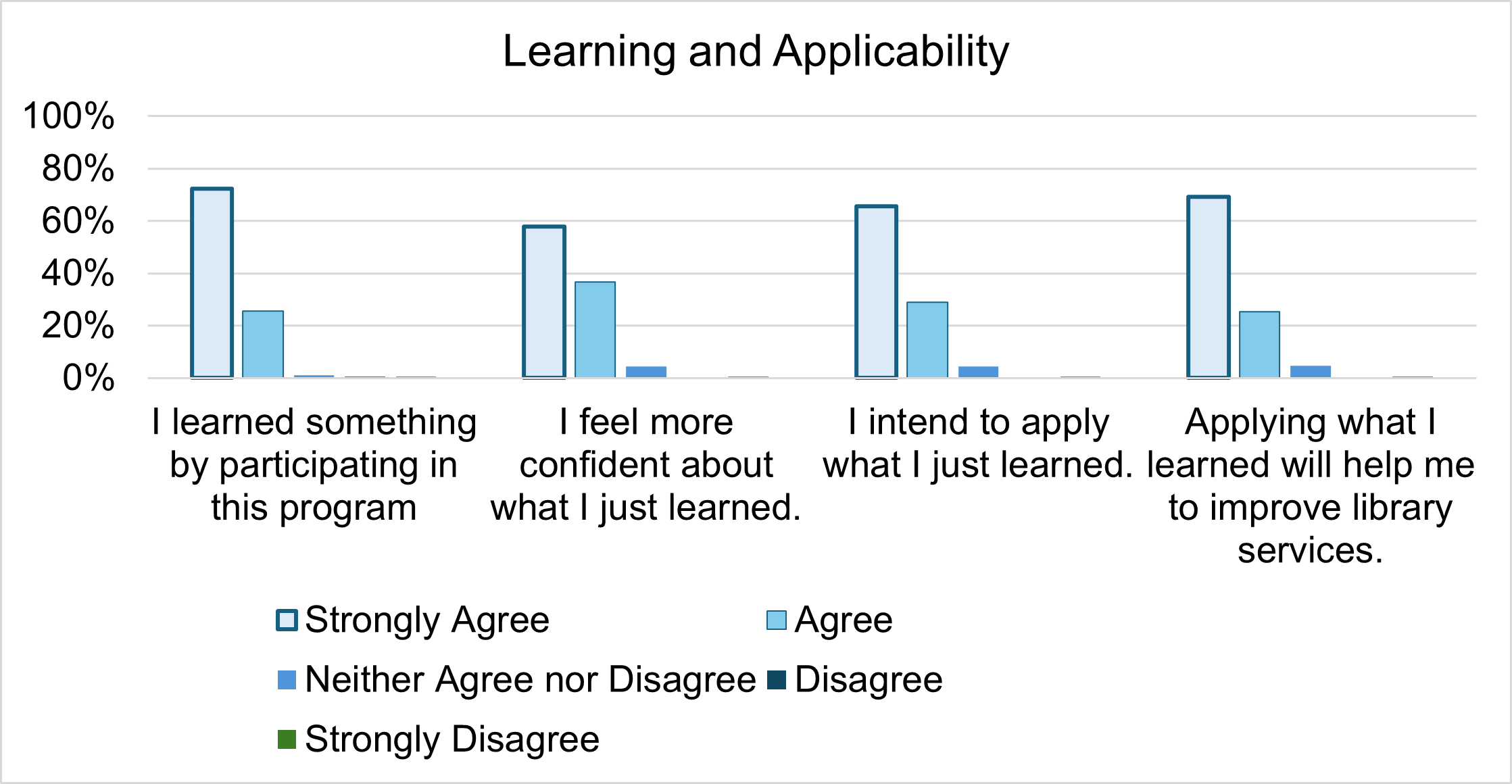
We asked participants “As a result of attending this session, to what extent do you agree with the following statements?” In general, participants strongly agreed with all statements and very rarely disagreed. The below details give insight into what people found the most helpful, as well as areas where CSL could improve or provide more training.
I Learned Something
The first statement was, “I learned something by participating in this program.” Of all statements, participants strongly agreed with this one the most. When people marked either agree or strongly agree, they also talked about at least one of the following concepts in their open-ended responses 100% of the time: Community, evaluation, intergenerational, networking, older adults, programs, teens. This tells us that people felt they learned the most when these topics came up.
I Feel More confident
95% of respondents marked either agree or strongly agree when asked if they feel more confident about what they just learned. In open-ended responses, 100% of people who talked about teens or networking either agreed or strongly agreed with feeling more confident. When respondents wrote about using the information for patrons, they tended to disagree that they felt more confident about what they learned. Fort-five percent of statements involving the word “patrons” were written by people who strongly disagreed with feeling more confident.
I’ll Apply What I Learned
When respondents wrote about older adults, evaluation, and teens, they also either agreed or strongly agreed that they’d apply what they learned to their work. However, when they wrote about literacy, they tended to disagree that they would apply what they learned to their work.
Applying What I Learned Will Improve Library Services
Respondents who either strongly agreed or agreed with this statement also wrote about intergenerational concepts, teens, networking, older adults, and evaluation. This closely mirrors the findings of what people learned. Literacy again remains an area in which people felt less sure about. Sixty-two percent of respondents who talked about “literacy” said they disagree that applying what they learned will improve library services. A tie could be drawn between the subjects people learned the most about and the improvement of library services.
Other Trends
Getting administrative buy-in was a relatively common topic in open-ended responses. All respondents that wrote about the subject said they’d like to see more information on the subject. Respondents who wrote about administrative buy-in also rated the program they’d attended as “excellent” 100% of the time. This was the same for networking: 100% of respondents who wrote about networking said the program was excellent. Wonderful presenters was the most common theme among open-ended responses. Followed by good information, and programming ideas. Respondents also regularly wrote about how grateful they were for the program and how helpful it was for them.
When we asked participants “What is one thing you learned that you will incorporate into your work?” the most common themes revolved around ideas, resources, programs, staff and patrons. Respondents often wrote about how interactive programs and engaging presenters enhanced their learning experience, as well as how collaborating with colleagues gave them new insights, empathy, and a sense of connection.
Room for Improvement
In all of the 408 open-ended responses, only seven contained notably negative comments. These comments included dislike for the presenter for various reasons including accessibility issues, lack of preparedness and over-subjectivity. One person felt like the program was marketed incorrectly and they didn’t get what they signed up for. There were 44 different suggestions for improvement or specific requests. Requests included more detailed information for niche topics, different presentation length, enhanced accessibility features (such as better color contrast on slides), and more ice breakers. A full list of specific requests is available upon request. Based on program satisfaction ratings and code occurrences a few future program topics clearly emerged: intergenerational programming, literacy, evaluation, networking, and administrative buy-in.